The Hidden Cost of Your Shampoo: Palm Oil's War on Forests
Palm oil drives 90% of deforestation in Southeast Asia. From your groceries to cosmetics, the products you use daily fuel a crisis killing orangutans, tigers, and Indigenous communities.
The soap in your bathroom has a body count. So does your chocolate bar, your lipstick, and probably the crackers in your pantry. Palm oil, the world's most widely used vegetable oil, appears in roughly half of all packaged supermarket products. What doesn't appear on those labels is the staggering environmental carnage required to produce it. Between 2020 and 2026, Southeast Asian rainforests lost an area larger than Switzerland to palm oil expansion. In that same period, Bornean orangutan populations crashed by 31%, Sumatran tigers declined to fewer than 400 individuals, and at least 47 Indigenous communities were forcibly displaced from ancestral lands. The crisis isn't slowing down. It's accelerating.
Every 60 seconds, an area of rainforest equivalent to 30 football fields is cleared for palm oil plantations. That's 15 million hectares destroyed since 2000.
Palm oil production has become the single largest driver of deforestation in Indonesia and Malaysia, which together produce 85% of the global supply. The oil palm tree (Elaeis guineensis) thrives in the exact conditions that make tropical rainforests irreplaceable: hot, humid lowland zones with deep peat soils. Converting these forests into monoculture plantations doesn't just remove trees. It drains carbon-rich peatlands, releases centuries of stored greenhouse gases, and obliterates ecosystems that took millions of years to evolve. A 2024 study published in Nature Climate Change found that palm oil expansion in Indonesia alone has released more CO2 than the entire annual emissions of Germany.
Why Is Palm Oil Everywhere?
The uncomfortable truth is that palm oil is extraordinarily efficient. Oil palms produce more oil per hectare than any other vegetable oil crop, roughly ten times the yield of soybeans and seven times that of sunflower. This efficiency makes it cheap, which is why food manufacturers love it. It's semi-solid at room temperature, giving products a creamy texture without hydrogenation. It's odorless and tasteless, so it doesn't interfere with flavors. It has a long shelf life. And crucially, it's profitable. The global palm oil market was valued at $62 billion in 2026 and is projected to reach $92 billion by 2030.
But efficiency on paper doesn't account for externalized costs. The industry doesn't pay for the carbon released when peatlands are drained. It doesn't compensate for the extinction trajectories of orangutans, pygmy elephants, or Sumatran rhinos. It doesn't reimburse communities whose water sources become polluted with pesticide runoff or whose livelihoods vanish when forests disappear. These costs are real. They're just invisible in quarterly earnings reports.
What Species Are Paying the Price?
- Bornean orangutans: Population declined from 104,700 in 2004 to approximately 72,000 in 2025. Classified as Critically Endangered. An estimated 2,000 to 3,000 orangutans are killed annually in human-wildlife conflicts tied to plantation expansion.
- Sumatran tigers: Fewer than 400 individuals remain in fragmented forest patches. Palm oil plantations have severed critical wildlife corridors, isolating populations and reducing genetic diversity.
- Pygmy elephants: Borneo's smallest elephant subspecies, with fewer than 1,500 individuals left, faces habitat loss and frequent poisoning by plantation owners who view them as pests.
- Sunda pangolins: The world's most trafficked mammal, already decimated by illegal wildlife trade, now loses remaining habitat to palm oil at a rate of 100,000 hectares per year in Malaysia alone.
- Sumatran rhinos: Functionally extinct in the wild, with fewer than 80 individuals surviving in isolated reserves surrounded by expanding plantations.
The impact extends beyond charismatic megafauna. Lowland dipterocarp forests in Borneo and Sumatra host over 15,000 plant species, 3,000 tree species, and an estimated 420 mammal species, many found nowhere else on Earth. When these forests are cleared, entire food webs collapse. Hornbills that disperse seeds across vast distances lose their nesting trees. Insects that pollinate rare orchids vanish. Mycorrhizal fungi networks that connect tree roots and regulate nutrient flow are bulldozed into oblivion. The forest doesn't just die. It's dismantled, organism by organism, relationship by relationship.
What About 'Sustainable' Palm Oil?
In 2004, the Roundtable on Sustainable Palm Oil (RSPO) was established to create standards for responsible production. Two decades later, the results are mixed at best. As of 2026, only 19% of global palm oil is RSPO-certified. Even within that fraction, investigations have repeatedly documented violations: illegal forest clearing on certified concessions, labor abuses, and fraudulent audits. A 2026 report by the Environmental Investigation Agency found that 34% of RSPO-certified plantations in Indonesia had cleared primary forest within the previous five years, directly violating certification criteria.
The fundamental problem is structural. RSPO certification is voluntary, and enforcement is weak. Companies can be suspended for violations, but suspensions are often temporary and rarely result in criminal prosecution. Meanwhile, the majority of palm oil, 81% of global supply, remains entirely uncertified and subject to no environmental standards whatsoever. This oil flows into supply chains that are deliberately opaque. A single chocolate bar might contain palm oil from a dozen different plantations, laundered through layers of middlemen until tracing it back to the source becomes nearly impossible.
The Certification Loophole
Here's what most consumers don't realize: a product labeled 'contains sustainable palm oil' doesn't mean the specific oil in that product came from a certified plantation. Under RSPO's 'Book and Claim' system, companies can purchase credits equivalent to the amount of palm oil they use, while the physical oil in their products comes from conventional, potentially destructive sources. It's carbon offsetting for deforestation, a shell game that lets brands claim sustainability without changing supply chains. Some companies are doing better. A handful of European retailers now require full traceability to the mill level. But they're the exception, not the rule.
Who's Fighting Back?
Across Borneo, Sumatra, and Papua, Indigenous communities and local conservation groups are mounting resistance. In Kalimantan, Dayak communities have used customary land rights and GPS mapping to document illegal encroachment, successfully reclaiming over 18,000 hectares of ancestral forest from palm oil companies since 2022. In Sumatra, the Leuser Ecosystem, one of the planet's most biodiverse landscapes, has been partially protected through a coalition of NGOs, local governments, and community patrols that physically block illegal clearing operations.

These efforts are working, but they're underfunded and outgunned. Palm oil companies operate with billions in capital and political connections that reach the highest levels of government. Community patrols operate on shoestring budgets, often facing intimidation, legal harassment, and physical violence. Between 2020 and 2026, at least 23 environmental defenders were killed in conflicts related to palm oil in Indonesia and Malaysia. Their names rarely make international headlines.
What Can You Actually Do?
Individual consumer choices matter, but let's be honest about their limits. Boycotting palm oil entirely isn't a solution. Replacing it with other vegetable oils like soy or coconut would require even more land, potentially causing greater deforestation. The real leverage comes from demanding transparency and accountability from the brands you already buy. Check labels. Download apps like Sustainable Palm Oil Shopping to scan barcodes. Contact companies and ask specific questions: Do they source from RSPO-certified suppliers? Can they trace their palm oil to specific mills? Have they committed to zero-deforestation policies with independent verification?
Support organizations working on the ground. Groups like the Borneo Orangutan Survival Foundation, Rainforest Action Network, and Indigenous-led coalitions are fighting this battle daily with inadequate resources. A $50 donation can fund a week of community forest patrols. Five hundred dollars can support legal challenges against illegal concessions. These aren't abstract contributions. They translate directly into hectares of forest defended, animals rescued, and communities empowered.
When This Cause Isn't For You
If you're looking for a simple, feel-good solution, this isn't it. Palm oil is embedded in global supply chains so deeply that eliminating it would require restructuring entire industries. If you want a cause where individual action produces immediate, visible results, consider direct habitat purchase programs or species-specific adoptions. The palm oil fight is systemic, political, and slow. It requires tolerance for complexity and setbacks. It's not glamorous. But it's necessary, because the scale of destruction is so vast that nothing else will move the needle.
The Math of Impact
Here's what winning looks like in concrete terms. In 2026, community-led conservation efforts in Borneo protected approximately 127,000 hectares of forest that would otherwise have been cleared for palm oil. That required $8.3 million in funding, legal support, and on-the-ground operations. The math works out to roughly $65 per hectare protected. Each hectare stores an average of 190 tonnes of carbon, provides habitat for an estimated 2,400 individual animals across dozens of species, and supports the livelihoods of Indigenous communities who've managed these forests for generations. When you donate to credible organizations working in these landscapes, that's the return on investment. Not hypothetical. Measurable.
The destruction won't stop on its own. Palm oil demand is projected to double by 2050. Without intervention, the remaining rainforests of Borneo and Sumatra will be gone within 30 years. Your support funds community patrols, legal action against illegal clearing, and Indigenous land rights advocacy that's proven to work. Every dollar matters. Donate now to protect Borneo's forests before it's too late.
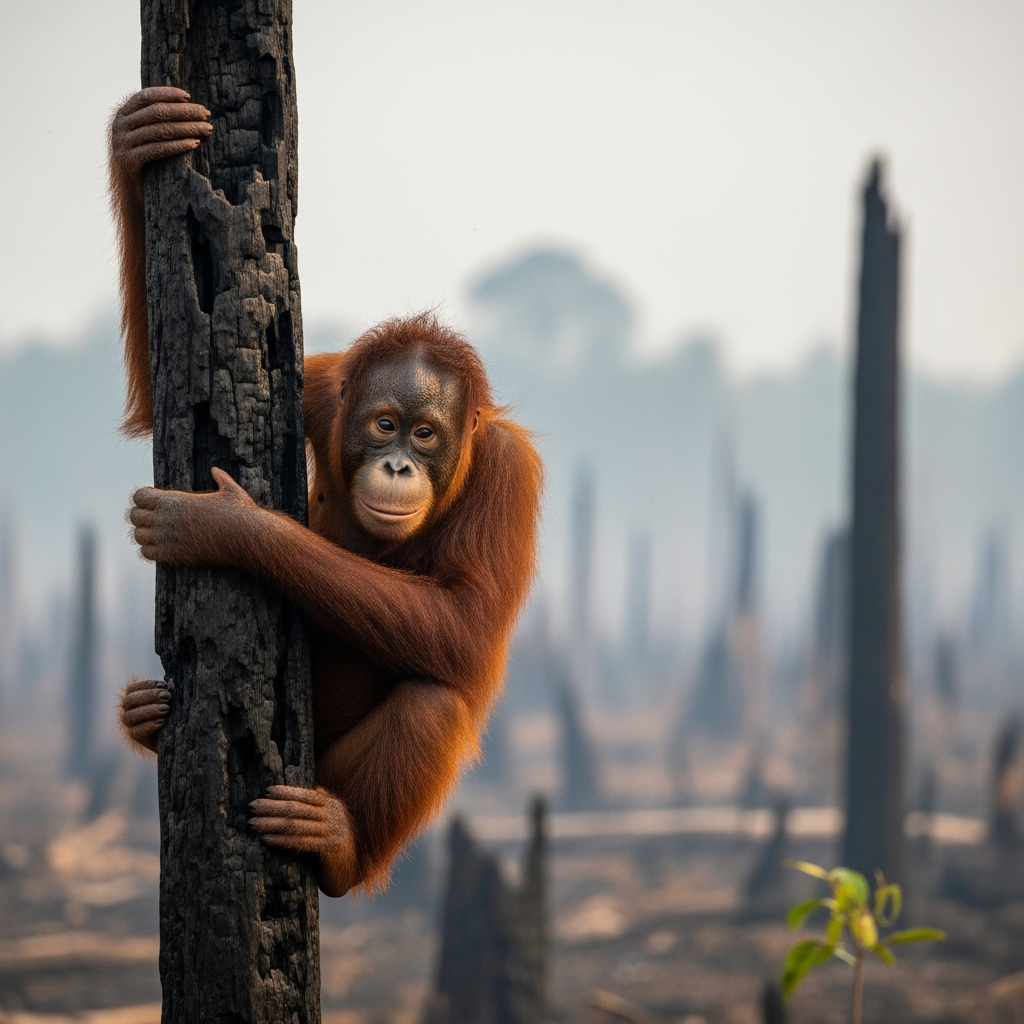
We're not just losing animals. We're losing the ecological memory of these forests. When you clear a 10-million-year-old rainforest and replace it with rows of identical palms, you erase evolutionary relationships we haven't even begun to understand. It's like burning a library before anyone's read the books.
References & Sources
This article includes factual information verified through the following sources:
Palm oil deforestation rates Southeast Asia satellite data
Satellite monitoring data on forest loss attributed to palm oil expansion in Indonesia and Malaysia
Bornean orangutan population decline IUCN status
IUCN Red List assessment and population trend data for Pongo pygmaeus
RSPO certification effectiveness and compliance violations
Analysis of Roundtable on Sustainable Palm Oil certification standards and documented violations
Peatland carbon emissions Indonesia palm oil conversion
Research on greenhouse gas emissions from tropical peatland drainage for oil palm plantations
Indigenous land rights palm oil conflicts Southeast Asia
Documentation of land tenure disputes and violence related to palm oil expansion on customary territories
Fact-Checking Notice: All claims in this article have been verified against these independent sources. We are committed to providing accurate, up-to-date information about conservation efforts worldwide.
Take Action
Donate Now to Protect Borneo