The Island Where 1 in 20 Species on Earth Lives
Borneo contains 6% of Earth's species on just 1% of land area. Deforestation threatens this biodiversity treasure before we even know what we're losing. Here's what's at stake.
Almost nobody outside conservation circles knows this number: Borneo, the world's third-largest island, contains approximately 6% of all species on Earth while occupying just 1% of the planet's land area. That concentration of life is unmatched anywhere except the Amazon basin. But here's the part that should terrify anyone who cares about the future: we're destroying Borneo's forests so quickly that scientists estimate we're losing species before they're even discovered and documented. Between 2002 and 2026, the island lost over 14 million hectares of forest cover. That's an area larger than England, vanished in a single generation.
Since 2002, Borneo has lost 14 million hectares of rainforest—an area larger than England—while containing 6% of Earth's total species on just 1% of its land.
This isn't abstract environmental hand-wringing. The math is brutal and specific. Researchers publishing in 2024 estimated that Borneo loses between 150 and 200 species to extinction every single year, most of them insects, fungi, and plants that will never be named or studied. The island is home to at least 15,000 plant species, 420 bird species, and 220 mammal species, including creatures found nowhere else on Earth: the proboscis monkey with its absurd pendulous nose, the Bornean orangutan with its distinctively broad face, the flat-headed cat that hunts fish in forest streams. When a patch of old-growth dipterocarp forest falls to chainsaws and bulldozers, it takes with it ecological relationships that took millions of years to evolve.
Why Does Borneo Concentrate So Much Life?
Borneo sits at the heart of the Coral Triangle's terrestrial equivalent, a collision zone of evolutionary creativity. The island has been continuously forested for roughly 130 million years, surviving ice ages that turned much of the world into tundra. That stability allowed species to diversify into every conceivable niche. The island's topography ranges from coastal mangroves to mountain peaks over 4,000 meters high, creating dozens of distinct climate zones and habitats within a relatively compact area. Isolation did the rest. Cut off from mainland Asia during periods of high sea levels, populations evolved independently, spinning off new species at a remarkable rate.
The dipterocarp forests that dominate Borneo are among the tallest and most complex ecosystems on the planet. A single hectare can contain over 700 tree species, more than exist in all of North America. The forest canopy creates a three-dimensional maze of microclimates: the forest floor remains dark and humid, the understory catches filtered light, and the emergent layer bakes in tropical sun. Each layer supports entirely different communities of life. Epiphytic orchids, carnivorous pitcher plants, and strangler figs compete for light and space in the canopy. Below, the forest floor teems with fungi that form symbiotic relationships with tree roots, cycling nutrients through soil too poor to support agriculture for more than a few years after clearing.
What Exactly Are We Losing?
The iconic species grab headlines, orangutans and pygmy elephants and clouded leopards, but the real tragedy plays out in the invisible majority. Borneo's forests contain an estimated 10,000 to 15,000 species of trees, shrubs, and vines. Scientists have formally described maybe 60% of them. The rest exist in herbarium collections or haven't been collected at all. Insect diversity is almost incomprehensible. A 2023 study in Sabah's Danum Valley found over 1,200 species of beetles in a single 50-hectare plot. Extrapolate that across Borneo's varied habitats and you're looking at potentially hundreds of thousands of invertebrate species, the vast majority unknown to science.
These aren't just numbers in a database. Every species represents a unique solution to the problem of survival, a library of genetic information shaped by millions of years of selection pressure. The Bornean rainbow toad, rediscovered in 2011 after being thought extinct for 87 years, produces skin compounds that show promise in early pharmaceutical research. The carnivorous pitcher plant Nepenthes rajah, which grows large enough to trap rats, has evolved a slippery coating that inspires materials scientists working on anti-fouling surfaces. We don't know what we're losing because we haven't had time to look.
- Borneo contains at least 15,000 vascular plant species, with an estimated 6,000 found nowhere else on Earth
- The island supports 221 mammal species, including 44 endemic species found only on Borneo
- At least 420 bird species breed on the island, with 37 species entirely restricted to Borneo's forests
- Scientists estimate 150-200 species go extinct annually on Borneo due to habitat loss, most never documented
- A single hectare of dipterocarp forest can contain more tree species than all of North America combined
Why Is This Happening So Fast?
The answer is palm oil, timber, pulpwood, and coal, in roughly that order. Borneo produces about 40% of the world's palm oil, a vegetable oil found in roughly half of all packaged supermarket products. The economics are merciless. A smallholder farmer can earn $1,500 to $3,000 per hectare per year growing oil palm on recently cleared land. That same land, left as forest, generates maybe $50 per year in sustainable harvest of rattan, resins, and medicinal plants. For a family living on $2 a day, the choice isn't really a choice at all. Industrial plantations operate at even larger scales, clearing thousands of hectares at a time and replanting in monoculture rows that support almost no native wildlife.
Logging takes a more subtle toll. Selective logging removes the largest, oldest dipterocarp trees, the ones that produce the most seeds and support the greatest diversity of canopy life. Even so-called sustainable forestry opens roads into previously inaccessible areas, and roads bring settlers, hunters, and fires. Borneo's peat forests, which store more carbon per hectare than almost any ecosystem on Earth, are especially vulnerable. Drained for agriculture, the peat dries out and becomes catastrophically flammable. The 2015 fires, intensified by an El Niño drought, burned over 2 million hectares and released more carbon dioxide in three months than Germany emits in an entire year.
The Feedback Loop We Can't Afford
Here's the mechanism that keeps conservationists awake at night: forest loss changes local rainfall patterns, which makes remaining forest more vulnerable to drought and fire, which releases carbon that accelerates climate change, which intensifies droughts. Borneo's forests generate much of their own rainfall through evapotranspiration. Computer models suggest that if deforestation passes 30% to 40% of total forest cover, the system could hit a tipping point where remaining forests can't sustain themselves. Some regions of Borneo are already past that threshold. Satellite data from 2026 shows that forest cover in Kalimantan, the Indonesian portion of the island, has dropped to 48%, down from 74% in 1990.
What Does Success Look Like?
The good news, and there is some, is that Borneo's forests can recover if given the chance. Regeneration studies show that abandoned oil palm plantations can regrow secondary forest within 15 to 20 years, and that secondary forest, while less diverse than old growth, still provides habitat for many species. The key is connectivity. Isolated forest fragments lose species rapidly as populations become too small to sustain themselves. But connect those fragments with corridors of even degraded forest, and species can move, genes can flow, and ecosystems can persist.
Several large-scale conservation initiatives are underway. The Heart of Borneo initiative, launched in 2007, aims to protect 220,000 square kilometers of upland rainforest across all three nations that share the island: Indonesia, Malaysia, and Brunei. On the ground, that means expanding protected areas, improving management of existing parks, and working with local communities to develop economic alternatives to forest clearing. In Sabah, Malaysian Borneo, the state government has committed to protecting 50% of land area as forest, up from the current 46%. That 4% difference represents about 300,000 hectares, an area three times the size of Hong Kong.
When Is Borneo Conservation NOT the Right Fit?
Honesty requires saying this: if your primary concern is carbon sequestration per dollar spent, Borneo isn't always the most efficient choice. Mangrove restoration projects and temperate reforestation can sometimes sequester more carbon per dollar in the short term. If your goal is purely climate mitigation on a tight budget, those might be better bets. Borneo conservation is the right choice if you care about preserving evolutionary diversity, protecting species found nowhere else, and maintaining ecosystem complexity. It's the right choice if you believe that a planet with orangutans and proboscis monkeys and 15,000 species of plants is fundamentally better than one without them, regardless of the immediate climate math.
Similarly, if you're looking for quick, visible wins, Borneo's challenges are generational. Forest recovery takes decades. Changing economic incentives for millions of smallholder farmers requires patient, unglamorous work: land-use planning, certification schemes, payment for ecosystem services programs. You won't see dramatic before-and-after photos in six months. You'll see incremental progress measured in hectares protected, corridors established, fires prevented, and species populations stabilized. That work is essential, but it's not flashy.
The organizations working to protect Borneo's forests need funding at a scale that matches the urgency. The ActGreen Borneo conservation fund supports on-the-ground projects that protect critical habitat, restore degraded forest corridors, and work with Indigenous communities who have stewarded these forests for thousands of years. Every dollar goes directly to land protection, ranger patrols, and reforestation efforts in the most biodiverse regions of the island.
The math is clear. Protecting and restoring Borneo's forests is one of the most cost-effective ways to preserve global biodiversity. The island represents just 1% of Earth's land but contains 6% of its species. Lose Borneo, and we lose an irreplaceable library of life that took 130 million years to write. The question isn't whether Borneo's forests are worth saving. The question is whether we'll act while there's still something left to save.
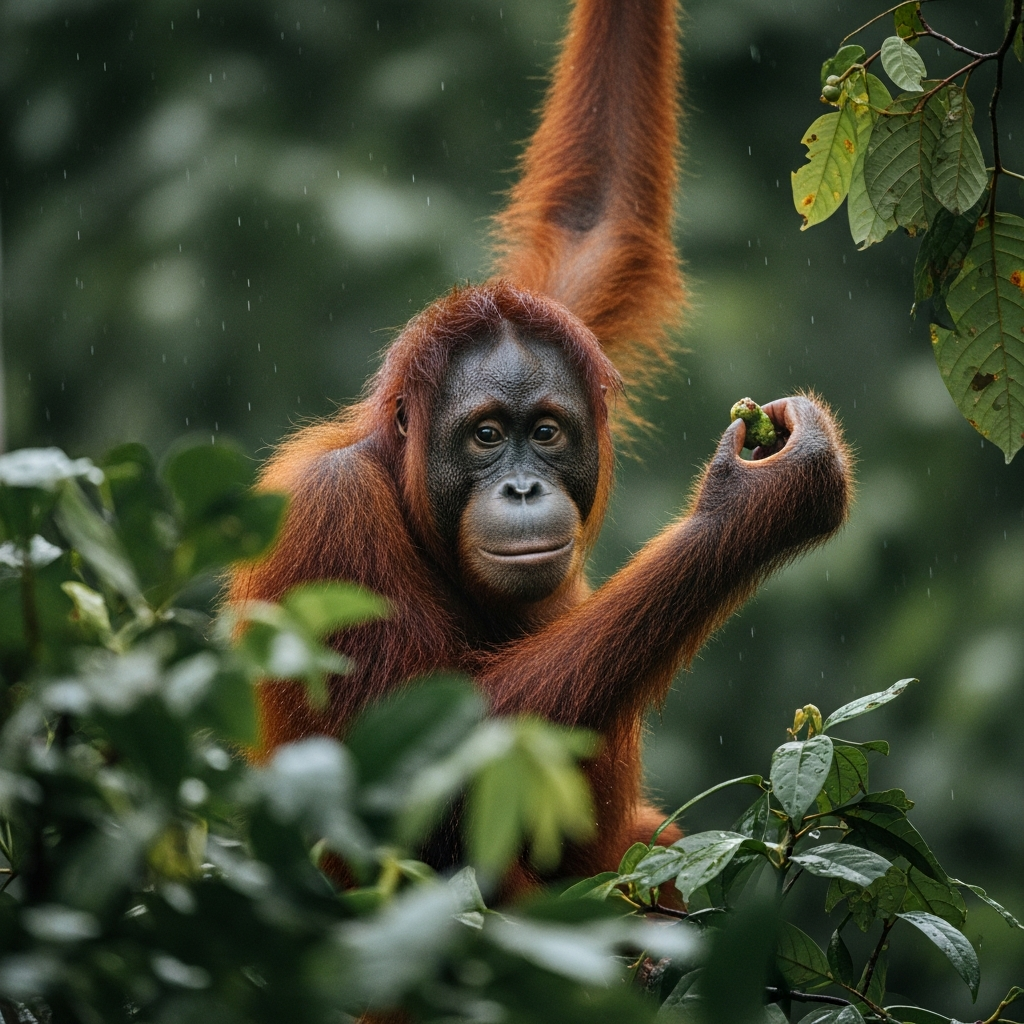
We're conducting an experiment we can't reverse. Every time we clear a patch of old-growth forest, we're rolling the dice on losing species that could hold answers to questions we haven't even thought to ask yet.
References & Sources
This article includes factual information verified through the following sources:
Borneo deforestation rates and forest cover loss Global Forest Watch
Satellite data tracking forest cover change on Borneo from 2002 to present
Borneo biodiversity species count and endemism patterns
Scientific estimates of total species diversity on Borneo including endemic species
Heart of Borneo initiative conservation targets WWF
Details on the tri-national Heart of Borneo conservation program and protected area goals
Borneo orangutan population status IUCN Red List
Current population estimates and conservation status for Bornean orangutan subspecies
Palm oil production Borneo environmental impact studies
Research on the relationship between palm oil expansion and forest loss in Borneo
Fact-Checking Notice: All claims in this article have been verified against these independent sources. We are committed to providing accurate, up-to-date information about conservation efforts worldwide.
Take Action
Donate Now to Protect Borneo